

 2 minute read
Azure VM Size Series Retirement 2028: Timeline and Migration Guidance
At Glance
What’s Changing?
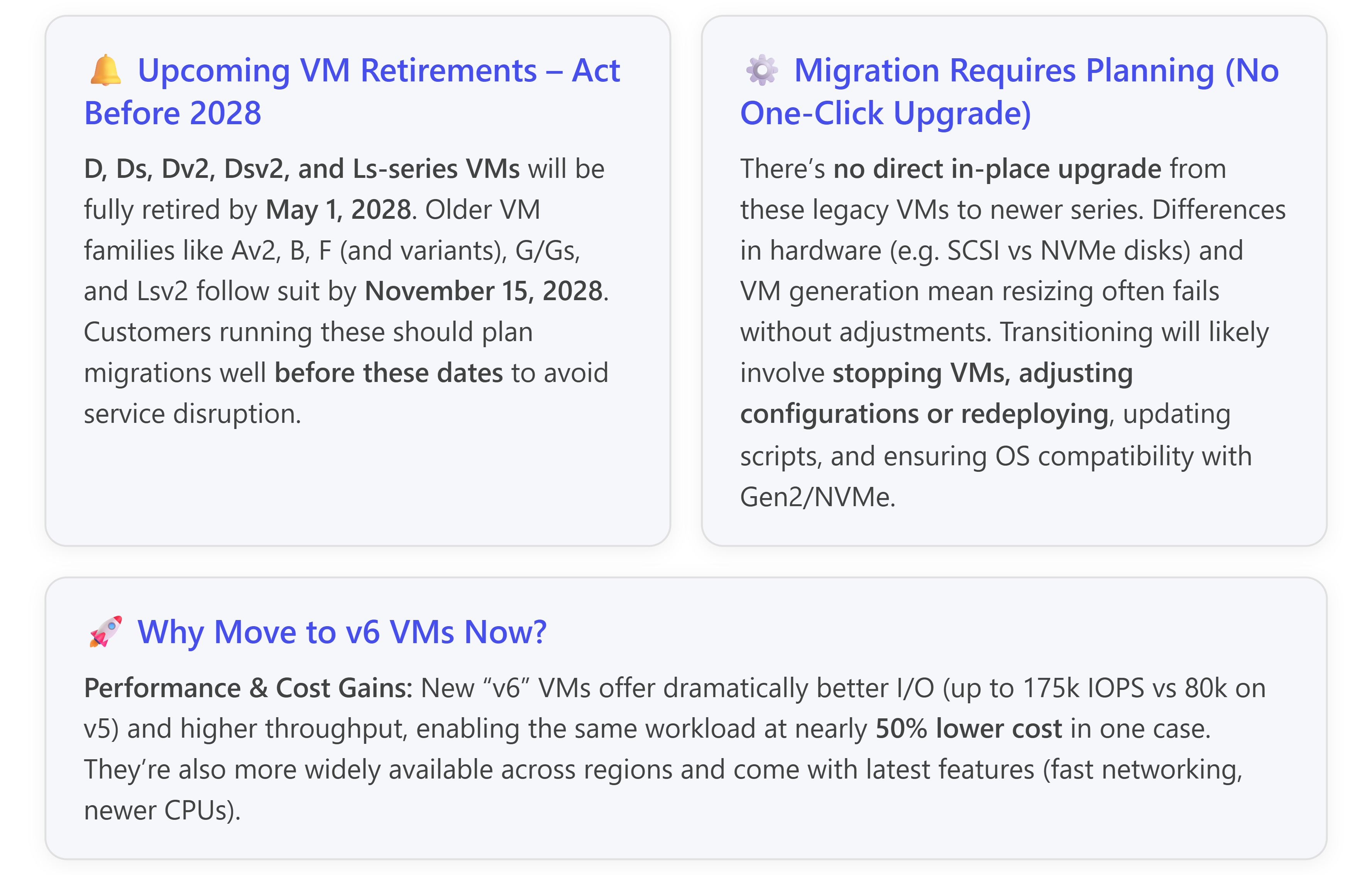
- No Auto-Upgrade: There’s no one-click path to newer VMs. Migration requires planning, downtime for resizing, and updates to scripts and configurations.
- Compatibility Matters: v6 VMs need Gen2 OS images and NVMe support. Older environments may require prep work before moving.
Why Upgrade Early?
- Performance Boost: New v6 VMs deliver up to 175K IOPS and 4,320 MB/s throughput—more than double the previous generation.
- Cost Savings: Real-world examples show up to 50% lower monthly costs by right-sizing workloads on v6.
- Future-Proofing: Gain access to premium storage, accelerated networking, and broader regional availability.
Retirement Timeline and Impacted VM Sizes
Microsoft officially announced the retirement of certain Azure VM series in two waves (March and October 2025 announcements) as part of an “Azure VM Series Retirement 2028” plan:
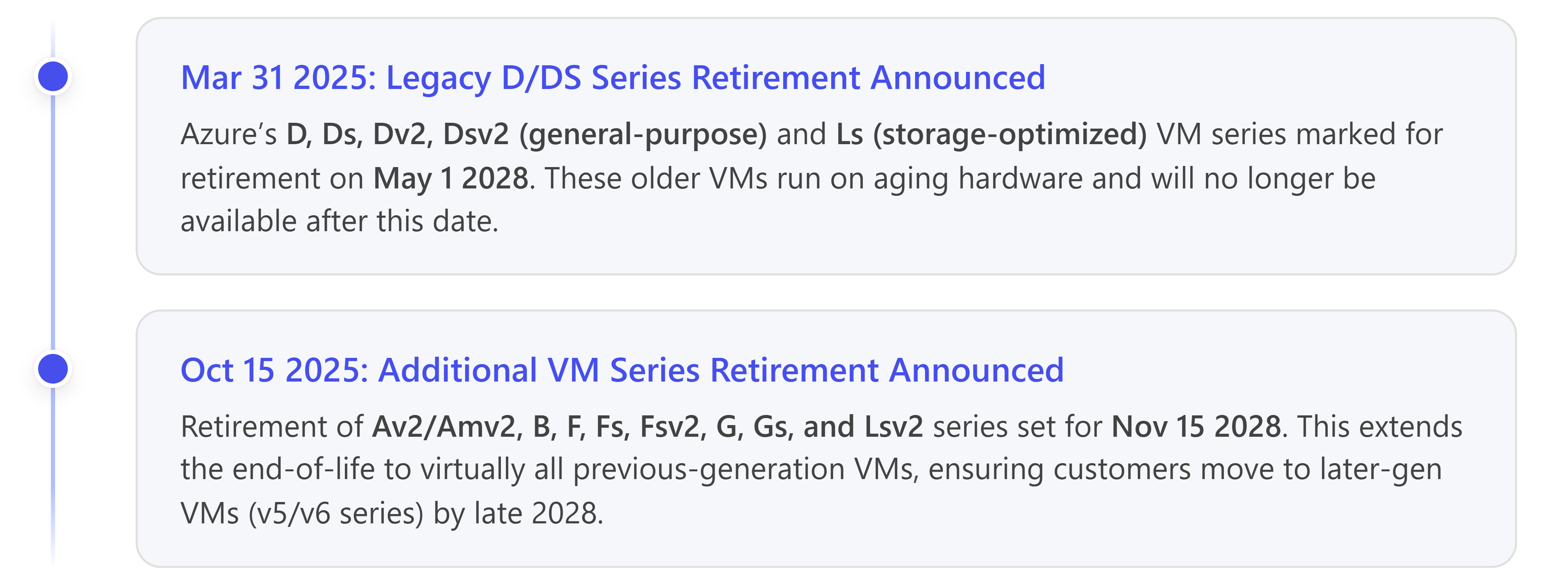
Impacted VM sizes: The D-family (D, Ds) and its v2 variants, plus the storage-optimized Ls-series, are among the first slated to retire. These include instance sizes from Standard_D1 up to D15_v2, and Standard_L4s up to L32s, among others. Later in 2028, older A-series (Av2), burstable B-series, compute-optimized F-series (including Fs, Fsv2), and large memory G/GS-series will follow. In short, any VM on older “v1/v2” generation hardware is on a clock for retirement.
For each retiring series, Microsoft provides recommended newer VM families as replacements. The table below summarizes key upcoming retirements and equivalent upgrade targets:
Key date: After the final retirement dates (May or Nov 2028), any remaining VMs of those sizes will be automatically deallocated (shut down) by Azure. They cannot be restarted, will no longer be billed, and will not be covered by SLA or support. In other words, customers must migrate off these VM sizes before these dates to avoid downtime. Microsoft has already begun restricting some of these sizes (e.g. in new subscriptions or regions) to encourage early transition.
Recommended Migration Targets
- D/Dv2 → Dsv5/Dsv6 or Dasv5/Dasv6
- Ls → Lsv3/Lasv3
Bottom Line & Next Steps
Migrating off retiring VMs isn’t an automatic process – it requires coordination between cloud admins and potentially application owners. Activities include updating deployment pipelines, ensuring the OS and software are compatible with new VM specs, scheduling downtime for resizing, and testing the new VMs thoroughly. Starting this process early is crucial; waiting until 2028 could lead to a rush and higher risk of issues. Start planning now! Early migration avoids last-minute rush and unlocks cost optimization opportunities. We can help assess your environment, design a roadmap, and execute a seamless transition.
Sources:
- Microsoft Learn – Retired Azure VM size series (official list of retiring VM families and dates)
- Azure Migration Guide – D/Dv2/DSv2/Ls-series Migration (guidance on moving to v5/v6, benefits of newer VMs)
- Azure Tech Community – Azure VM retirement announcements (confirmation of 2028 retirement timeline)
- Azure Q\&A – “Unable to change VM size v5 to v6” (illustrating direct upgrade limitations and need for redeployment)
- LinkedIn – “Announcing Azure VM v6 – Performance and Cost Optimization” (details on v6 improvements: IOPS, throughput, cost savings)
- Michele Blum (Cloud Architect) – “End of Support for D/Dv2… VMs” (overview of retirement and why to migrate, used for cross-reference)